Write Confidently, Score Higher with AnswerWriting
Refine your UPSC/PCS Mains answers with clinical precision. Our AI-driven evaluation ensures clarity, relevance, and structured writing — helping you improve with every attempt.
Tip: Cite a recent SC judgement in the introduction to strengthen your opening.
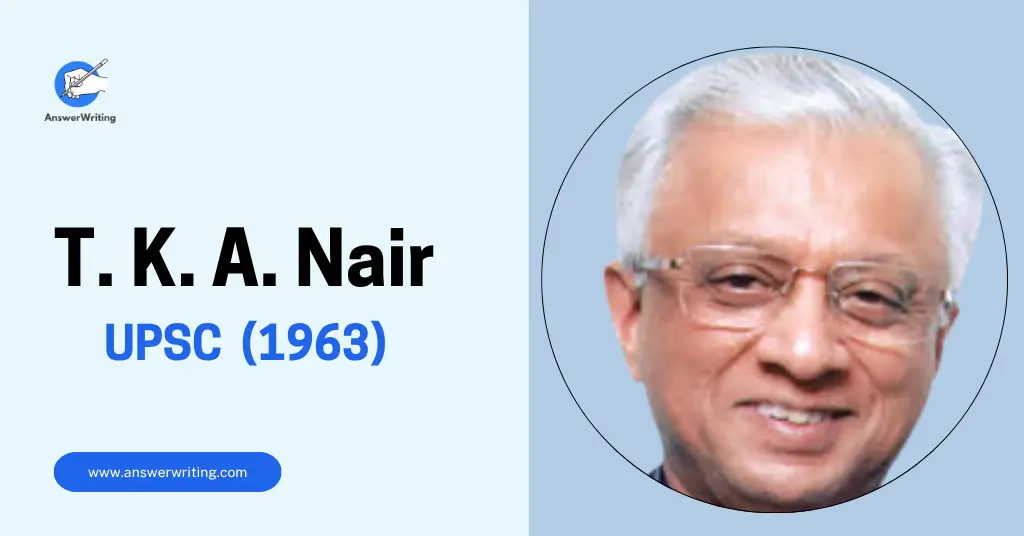
T. K. A. Nair: UPSC 1963, Strategy, and the Journey of India’s PMO Architect | AnswerWriting
T. K. A. Nair: UPSC 1963, Strategy, and the Journey of India’s PMO Architect
What does it take for a single civil servant to become the “right-hand man” for three different Prime Ministers of varying political ideologies? T. K. A. Nair provides the answer.
From his selection in the 1963 UPSC batch to his seven-year tenure as Principal Secretary to the Prime Minister, his journey is a masterclass in administrative excellence, neutrality, and the power of a disciplined mind.
Who Is T. K. A. Nair?
Thottuvelil Krishna Pillai Ayyappan Nair, popularly known as T. K. A. Nair, is a retired 1963-batch IAS officer of the Punjab cadre. Born in 1939 in Ayiroor, Kerala, he rose through the ranks to serve at the pinnacle of the Indian bureaucracy. He is best known for his unprecedented influence in the Prime Minister’s Office (PMO), serving under I. K. Gujral, Atal Bihari Vajpayee, and Dr. Manmohan Singh.
Feature
Details
Full Name
T. K. A. Nair
Batch
1963
Service
Indian Administrative Service (IAS)
Cadre
Punjab
Key Position
Principal Secretary to the Prime Minister (2004–2011)
Education
B.A. (Hons) History, University College Thiruvananthapuram
T. K. A. Nair UPSC Success Context
In 1963, the UPSC Civil Services Examination was a different beast. The competition was fierce but limited to a smaller pool of applicants compared to today’s millions. However, the lack of centralized coaching and digital resources meant that aspirants had to rely on sheer intellectual depth and library research. Nair emerged as a top performer in this rigorous environment, earning a spot in the prestigious Punjab cadre.
Educational Background and Early Life
T. K. A. Nair’s academic foundation was built on the study of the past to understand the future. He studied History at the iconic University College in Thiruvananthapuram. This choice of subject was not merely academic; it helped him develop a panoramic view of governance, society, and the evolution of political systems.
His early life in Kerala instilled in him a sense of social justice and a quiet, persistent work ethic. By the time he appeared for the UPSC, he was already equipped with the “Administrative Temperament” that interview boards look for: the ability to listen, analyze, and decide without bias.
How Many Attempts Did T. K. A. Nair Take?
T. K. A. Nair cleared the UPSC Civil Services Examination in his very first attempt. During the 1960s, many candidates entered the service at a young age, often straight out of post-graduation.
His success came from a focused approach to the basics. He did not treat the exam as a separate entity from his academic life; instead, he integrated his university learning with a deep awareness of national and international affairs.
Optional Subject Choice: The Power of History
Nair chose History as his optional subject, a field in which he had already demonstrated excellence. In the 1960s, History was a popular choice because it provided a stable foundation for the General Studies papers.
Analytical Depth: History taught him to look for patterns in governance, a skill that later made him indispensable in the PMO.
Narrative Writing: The subject helped him develop a lucid writing style, essential for drafting the complex policy notes that characterize the life of a senior bureaucrat.
For modern aspirants, picking an optional subject should be based on similar “strength-mapping.” While times have changed, the logic of picking a subject you genuinely enjoy remains the same. If you are struggling with this choice, utilizing an AI Mentor on AnswerWriting.com can help you compare different subjects against your background and scoring potential.
UPSC Preparation Strategy of T. K. A. Nair
Nair’s strategy was rooted in “Total Immersion.” Without the internet, his world revolved around standard textbooks and newspapers.
Drafting Precision: He practiced writing summaries of long articles to improve his ability to condense information.
Breadth of Reading: He read extensively on philosophy and sociology, which gave his answers a maturity that set him apart.
Neutrality: He practiced looking at administrative problems from multiple perspectives, a trait that allowed him to work harmoniously with leaders of different political stripes.
Books and Resources Recommended for Foundation
While many books from the 1960s are now out of print, Nair’s foundational approach maps perfectly to modern standard resources.
Subject
1960s Core Resource
Modern Equivalent
History
Advanced History of India (R.C. Majumdar)
Bipan Chandra / Spectrum
Polity
Constitution of India (M.V. Pylee)
M. Laxmikanth
Economy
Five-Year Plan Documents
Economic Survey / Budget
World Affairs
International Relations texts
Current Affairs (The Hindu)
Mains Answer Writing Approach
In the 1963 exam, the word limits were strict, and the demand for logical flow was absolute. Nair focused on “Clarity and Conciseness.” He avoided flowery language, preferring instead to present his arguments in a structured, point-by-point format that made it easy for examiners to award marks.
Today’s aspirants face a similar challenge: packing vast amounts of information into small answer boxes. To master this, many use the Answer Evaluator on AnswerWriting.com to get instant AI-driven feedback on their structure and language. This mirrors the peer-review and self-correction process that toppers like Nair had to perform manually decades ago.
Interview (Personality Test) Experience
T. K. A. Nair’s interview was marked by his soft-spoken but firm articulation. He did not try to impress the board with jargon; instead, he displayed a deep understanding of India’s developmental challenges. The board saw in him a man of quiet competence: a bureaucrat who could manage the pressure of a state like Punjab, which was then undergoing significant transformation.
Service and Cadre Allotted: The Punjab Chapter
Allotted to the Punjab cadre, Nair served in various capacities before moving to the center. He served as the Chief Secretary of Punjab during a period of industrial and agricultural growth. His success there led him to the Prime Minister’s Office, where he eventually spent seven years as the Principal Secretary to Dr. Manmohan Singh, acting as the bridge between the government and the bureaucracy.
Key Lessons Every UPSC Aspirant Can Take from T. K. A. Nair
Focus on Consensus: Administration is about taking people along. Learn to build arguments that are inclusive and balanced.
Drafting is a Superpower: Whether in the exam or in the PMO, your ability to write clear, logical notes is your greatest asset.
Lifelong Learning: Nair continued to evolve his understanding of governance long after his UPSC days, adapting to the digital shift and changing global economies.
Neutrality: A civil servant serves the Constitution, not a party. Maintaining this professional distance is the key to a long and respected career.
FAQs About T. K. A. Nair
Which year did T. K. A. Nair clear the UPSC?
He cleared the exam in 1963 and joined the Indian Administrative Service.
Under which Prime Ministers did he serve?
He served in various high-ranking capacities under I. K. Gujral, Atal Bihari Vajpayee, and most notably as Principal Secretary to Dr. Manmohan Singh.
What was his optional subject?
He chose History, reflecting his academic background from University College Thiruvananthapuram.
Which cadre was he allotted?
He was allotted the Punjab cadre, where he eventually rose to the position of Chief Secretary.
What is his current role?
Post-retirement, he has been involved in several charitable and educational initiatives in Kerala and continues to mentor young aspirants and public servants.