Write Confidently, Score Higher with AnswerWriting
Refine your UPSC/PCS Mains answers with clinical precision. Our AI-driven evaluation ensures clarity, relevance, and structured writing — helping you improve with every attempt.
Tip: Cite a recent SC judgement in the introduction to strengthen your opening.
Srivatsa Krishna: UPSC Rank 1, Strategy, and the Legend of the 1994 Topper | AnswerWriting
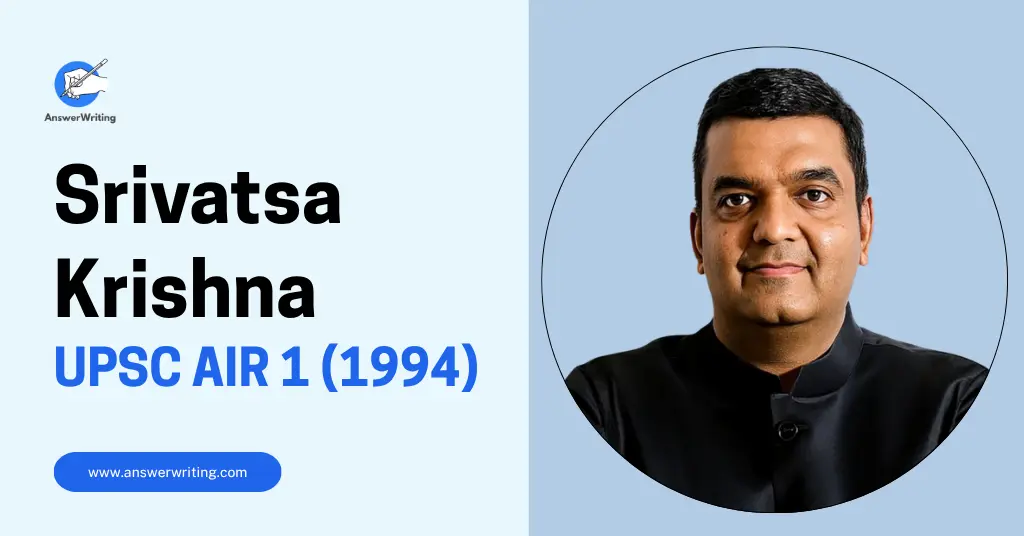
Srivatsa Krishna: UPSC Rank 1, Strategy, and the Legend of the 1994 Topper
In 1994, Srivatsa Krishna achieved a feat that remains a benchmark in the history of the Civil Services Examination. He secured All India Rank 1 in his very first attempt, reportedly clocking some of the highest marks ever recorded under that specific exam pattern.
His journey from the hallowed halls of St. Stephen’s to the top of the UPSC merit list serves as a blueprint for academic excellence and strategic planning.
Who Is Srivatsa Krishna?
Srivatsa Krishna is an IAS officer of the 1994 batch belonging to the Karnataka cadre. Born into a family that valued education, he quickly distinguished himself as a brilliant scholar. After topping the UPSC, he became known for his expertise in IT, infrastructure, and e-governance. He later became the first serving IAS officer to complete an MBA from Harvard Business School.
Feature
Details
Full Name
Srivatsa Krishna
UPSC Rank
AIR 1
Year of Exam
1994
Attempt Number
First Attempt
Service Allotted
Indian Administrative Service (IAS)
Cadre
Karnataka
Optional Subjects
Political Science & International Relations, Psychology
Srivatsa Krishna UPSC Marksheet and Score Details
While the UPSC did not release marks in the digital format we see today, Krishna’s performance was widely analyzed in educational journals of the time. He reportedly scored exceptionally well in both his optional subjects, which carried him past the competition.
Paper
Marks Obtained (Approx. as per reports)
General Studies
High Distinction
Optional 1 (PSIR)
Record-breaking score
Optional 2 (Psychology)
Exceptional
Interview (Personality Test)
Highly Rated
Final Result
All India Rank 1
Educational Background and Early Life
Srivatsa Krishna’s academic journey is as prestigious as his professional one. He studied at St. Stephen’s College in Delhi, an institution known for producing a high volume of bureaucrats. His time there helped him develop the sharp analytical skills required for the UPSC.
He was also a Rhodes Scholar candidate and eventually went on to study at Oxford University. This international exposure allowed him to view Indian administrative challenges through a global lens. His background proves that a strong foundation in reading and critical thinking is the biggest asset for any aspirant.
How Many Attempts Did Srivatsa Krishna Take?
Srivatsa Krishna is one of the few toppers to crack the exam in his very first attempt. He did not treat his first try as a “trial run.” Instead, he approached the 1994 exam with a “do or die” mindset.
He emphasizes that what changed his trajectory was not just hard work, but extreme efficiency. He focused on the quality of hours spent rather than just the quantity. For modern aspirants, this means using tools like an AI Mentor from AnswerWriting.com to identify preparation gaps early, ensuring that the first attempt is the final one.
Srivatsa Krishna Optional Subject: Why They Chose It and How They Scored
At the time, the UPSC required candidates to choose two optional subjects. Krishna chose Political Science & International Relations (PSIR) and Psychology.
PSIR: This subject aligned with his interest in global affairs and governance. It also overlapped significantly with General Studies, saving him precious preparation time.
Psychology: He chose this for its scientific nature and high scoring potential.
His strategy involved treating optional subjects as the “score boosters.” He dived deep into original texts rather than relying solely on coaching notes. This gave his answers a level of maturity that distinguished him from other candidates.
UPSC Preparation Strategy of Srivatsa Krishna
Krishna’s strategy was built on the pillars of “Integrated Learning.” He did not look at Prelims and Mains as separate entities. He studied the core concepts of the syllabus in depth, which naturally prepared him for both stages.
He followed a strict 10 to 12-hour study schedule during the peak months. He was known for making concise, cross-referenced notes. These notes allowed him to link current events with theoretical concepts, a skill that is still vital for scoring well in GS papers today.
Books and Resources Recommended by Srivatsa Krishna
While the syllabus has evolved, the foundational texts Krishna recommended remain relevant for building conceptual clarity.
Subject
Book/Resource
Author/Source
Polity
Indian Constitution
D.D. Basu / P. Bakshi
International Relations
Global Politics
Standard Journals/The Hindu
Psychology
Introduction to Psychology
Morgan and King
History
India’s Struggle for Independence
Bipan Chandra
General Science
NCERTs (Class 6-10)
NCERT
Mains Answer Writing Approach
Srivatsa Krishna believed that the Mains exam is a test of how you present what you know, not just how much you know. His answers were characterized by:
Directness: He answered the question asked, not the topic he knew.
Multidimensionality: He included economic, social, and political angles in every GS answer.
Data-Backed Arguments: He used facts and figures to support his claims.
In today’s competitive landscape, achieving this level of precision requires constant feedback. Using an Answer Evaluator on platforms like AnswerWriting.com can help you mirror this “topper style” by providing instant analysis of your structure and content quality.
Interview (Personality Test) Experience
Krishna’s interview was a reflection of his confident and articulate personality. He was questioned extensively on his views on the Indian economy and the role of technology in governance.
He advises aspirants to be honest during the interview. If you do not know an answer, it is better to admit it politely than to bluff. The board looks for “trainability” and “integrity” rather than an encyclopedia of facts.
Service and Cadre Allotted to Srivatsa Krishna
Upon ranking first in the country, Srivatsa Krishna was allotted the Indian Administrative Service (IAS) in the Karnataka cadre. His career has been unconventional. He took a leave of absence to pursue an MBA from Harvard and worked with the World Bank.
In India, he played a pivotal role in the IT department in Karnataka and was instrumental in various e-governance initiatives. His career proves that an IAS officer can have a massive impact by combining traditional administration with modern management techniques.
Key Lessons Every UPSC Aspirant Can Take from Srivatsa Krishna
Efficiency Over Bulk: Do not just collect books. Focus on a few high-quality resources and master them.
Integrated Preparation: Start your Mains preparation early. Use tools like MCQ Practice for Prelims as a way to test your core knowledge, but keep your eyes on the descriptive papers.
Global Mindset: Read widely. Understanding global trends helps you write better answers in International Relations and Economics.
Confidence is Key: Whether it is the exam hall or the interview room, believing in your preparation is half the battle won.
FAQs About Srivatsa Krishna
What was Srivatsa Krishna’s rank in UPSC?
He secured All India Rank (AIR) 1 in the 1994 Civil Services Examination.
How many attempts did Srivatsa Krishna take?
He cleared the exam in his very first attempt.
What were his optional subjects?
His optional subjects were Political Science & International Relations and Psychology.
Which cadre was he allotted?
He was allotted the Karnataka cadre of the IAS.
Is Srivatsa Krishna still in service?
As per latest public records, he has served in various senior capacities for the Government of India and the Karnataka Government, alongside his stints with international organizations.
Where did he go for his MBA?
He earned his MBA from Harvard Business School, becoming one of the first IAS officers to do so while in service.