Write Confidently, Score Higher with AnswerWriting
Refine your UPSC/PCS Mains answers with clinical precision. Our AI-driven evaluation ensures clarity, relevance, and structured writing — helping you improve with every attempt.
Tip: Cite a recent SC judgement in the introduction to strengthen your opening.
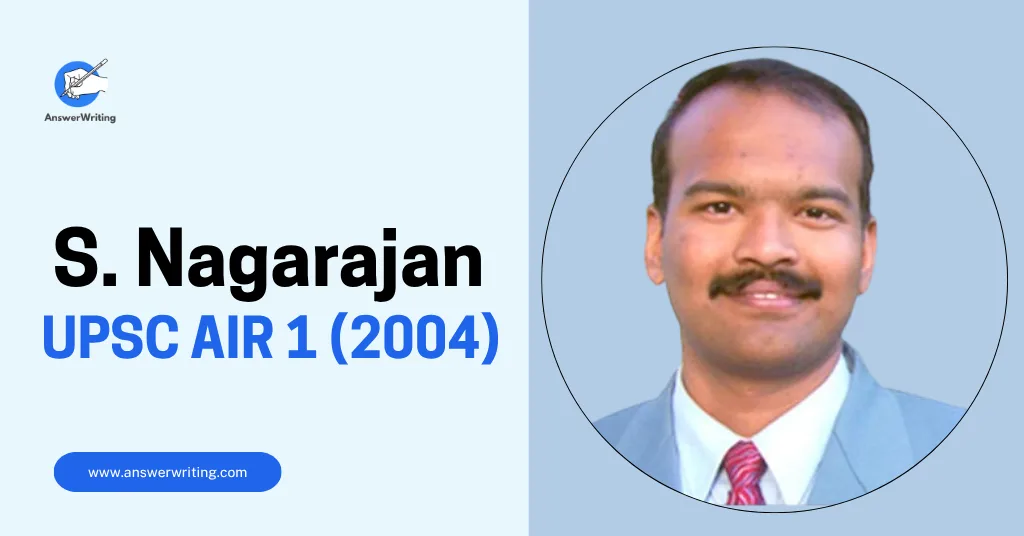
S. Nagarajan: UPSC Rank 1, Strategy, and Journey | AnswerWriting
S. Nagarajan: UPSC Rank 1, Strategy, and Journey
Should an aspirant stick to their graduation subject even if it is not yielding marks? For S. Nagarajan, the answer was a bold “no.” His journey to the top of the UPSC merit list is a masterclass in strategic flexibility. He didn’t just work hard; he worked smart by analyzing his failures and pivoting when necessary.
Nagarajan’s story is particularly relevant for engineering students who struggle with technical optionals. He proved that an AIR 1 doesn’t require sticking to your roots, but rather finding the path of least resistance to high marks.
Who Is S. Nagarajan?
S. Nagarajan is a 2005-batch IAS officer currently serving in the Tamil Nadu cadre. Hailing from Tirunelveli, he brought a disciplined, engineering mindset to the humanities-heavy UPSC syllabus.
Feature
Details
Full Name
S. Nagarajan
UPSC Rank
AIR 1
Exam Year
2004 (2005 Batch)
Service Allotted
Indian Administrative Service (IAS)
Cadre
Tamil Nadu
Optional Subjects
Geography and Sociology
Educational Background
B.E. in Electrical and Electronics (BITS Pilani)
S. Nagarajan UPSC Marksheet and Score Details
Nagarajan’s success was defined by a massive jump in his interview marks and consistent performance across his new optional subjects.
Paper
Marks Obtained
General Studies
322 / 600
Optional 1 (Geography)
358 / 600
Optional 2 (Sociology)
357 / 600
Essay
110 / 200
Written Total
1147 / 2000
Personality Test
210 / 300
Final Total
1357 / 2300
Educational Background and Early Life
S. Nagarajan was born into a family that valued education and public service. He completed his schooling at Chinmaya Vidyalaya in Tirunelveli. Even as a young student, he was fascinated by the impact a District Collector could have on society.
He moved to Rajasthan to pursue a Bachelor of Engineering in Electrical and Electronics at the prestigious BITS Pilani. While his technical education sharpened his analytical skills, he realized midway through his college years that his heart lay in the civil services. This clarity allowed him to begin his mental preparation long before he officially picked up a UPSC book.
How Many Attempts Did S. Nagarajan Take?
Nagarajan’s path to AIR 1 was not a single-shot victory. It took him four attempts to reach the pinnacle:
First Attempt: He reached the interview stage but failed to find a place in the final list.
Second Attempt: He secured AIR 137 and was allotted the Indian Railway Traffic Service (IRTS).
Third Attempt: He attempted the exam while in service but could not improve his rank significantly.
Fourth Attempt: He took a bold “extraordinary leave” from his training. He dedicated one full year to correcting his mistakes, leading to AIR 1.
The most critical change between his second and fourth attempts was his choice of subjects and his focus on the personality test. He realized that technical subjects like Electrical Engineering were too vast and unpredictable for the Mains.
S. Nagarajan Optional Subject: The Bold Switch
Nagarajan originally chose Electrical Engineering and Physics (two optionals were required then). Despite being an engineer, he found that the UPSC syllabus for these subjects was significantly more theoretical and time-consuming than his college curriculum.
He made the difficult decision to switch to Geography and Sociology. This wasn’t just a random choice. He selected Geography because it was semi-scientific and visual, and Sociology because it was manageable and had high overlap with the Essay paper.
Attempt
Optional 1
Optional 2
Result
1st & 2nd
Electrical Eng.
Physics
Rank 137
4th
Geography
Sociology
Rank 1
UPSC Preparation Strategy of S. Nagarajan
Nagarajan treated UPSC like a project. He didn’t believe in counting hours but in completing targets. He broke the syllabus into small, digestible modules.
Prelims Strategy
He focused heavily on basic NCERTs and previous year question papers. He believed that the Prelims is less about knowing everything and more about the “art of elimination.” To sharpen this, aspirants today often use tools like MCQ Practice for Prelims on AnswerWriting.com, which allows for topic-wise drilling to ensure no conceptual gaps remain.
Mains Strategy
For the Mains, he followed a “note-making” approach. For every sub-topic in the syllabus, he prepared a 200-word template. This meant that on the day of the exam, he wasn’t “thinking” of what to write; he was simply “retrieving” his pre-prepared templates.
Books and Resources Recommended by S. Nagarajan
Subject
Book/Resource
Author/Source
Polity
Indian Polity
M. Laxmikanth
Economy
Indian Economy
Dutt and Sundaram
Geography
Physical Geography
Savindra Singh
Geography
Certificate Physical Geography
GC Leong
Sociology
Sociology: Themes and Perspectives
Haralambos and Holborn
Modern History
A Brief History of Modern India
Spectrum (Rajiv Ahir)
Mains Answer Writing Approach
Nagarajan’s answer writing was structured and visual. In Geography, he ensured that every answer had a map or a diagram. He argued that a diagram conveys in ten seconds what a paragraph takes two minutes to explain.
For Sociology, his answers were balanced, presenting multiple sociological perspectives (Marxist, Functionalist, etc.) for every issue. He emphasized that handwritten practice is the only way to build muscle memory.
In the modern context, getting this practice evaluated is crucial. Platforms like AnswerWriting.com offer an Optional Evaluator that benchmarks your answers against subject-specific standards, much like the peer-review system Nagarajan used during his stay in Delhi’s Rajinder Nagar.
Interview (Personality Test) Experience
In his earlier attempts, Nagarajan’s interview scores were average (around 150-160). For his fourth attempt, he worked on his communication and body language. He realized the board wasn’t testing his knowledge (which was already proven in the Mains) but his “administrative temperament.”
He remained calm when he didn’t know an answer, politely stating that he would look it up. This honesty, combined with his depth of knowledge on his home state (Tamil Nadu) and his engineering background, helped him secure a massive 210 marks.
Service and Cadre Allotted to S. Nagarajan
As AIR 1, Nagarajan had his pick of services and cadres. He chose the Indian Administrative Service (IAS) and his home cadre, Tamil Nadu.
Since then, he has held several high-profile positions, including:
District Collector: Serving in districts like Kanyakumari.
Health Department: Playing a key role in public health administration.
Commercial Taxes: Serving as the Commissioner of Commercial Taxes in Tamil Nadu.
Director of e-Governance: Leveraging his BITS Pilani background to digitize government services.
Key Lessons Every UPSC Aspirant Can Take from S. Nagarajan
Don’t Fear the Switch: If your graduation subject is dragging your marks down, have the courage to pick a more “scoring” humanities optional.
Prepare Templates: Don’t wait for the exam hall to structure your thoughts. Have 200-word summaries ready for every syllabus point.
The Interview is a Game-Changer: A 50-mark jump in the personality test can take you from the bottom of the list to AIR 1.
Analyze Your Failures: Nagarajan didn’t just study harder in his 4th attempt; he studied differently based on his previous scorecards.
FAQs About S. Nagarajan
What was S. Nagarajan’s optional subject?
In his successful AIR 1 attempt, his optional subjects were Geography and Sociology.
How many attempts did S. Nagarajan take?
He cleared the exam in his 4th attempt. He had previously secured AIR 137 in his 2nd attempt.
Which college did S. Nagarajan attend?
He is an alumnus of BITS Pilani, where he completed his B.E. in Electrical and Electronics Engineering.
Is S. Nagarajan from Tamil Nadu?
Yes, he hails from Tirunelveli, Tamil Nadu, and is currently serving in the Tamil Nadu cadre.
What was S. Nagarajan’s rank in 2005?
S. Nagarajan secured All India Rank (AIR) 1 in the 2004 UPSC Civil Services Examination (2005 batch).
What was S. Nagarajan’s score in the UPSC interview?
In his AIR 1 attempt, he scored 210 out of 300 marks in the personality test.