Write Confidently, Score Higher with AnswerWriting
Refine your UPSC/PCS Mains answers with clinical precision. Our AI-driven evaluation ensures clarity, relevance, and structured writing — helping you improve with every attempt.
Tip: Cite a recent SC judgement in the introduction to strengthen your opening.
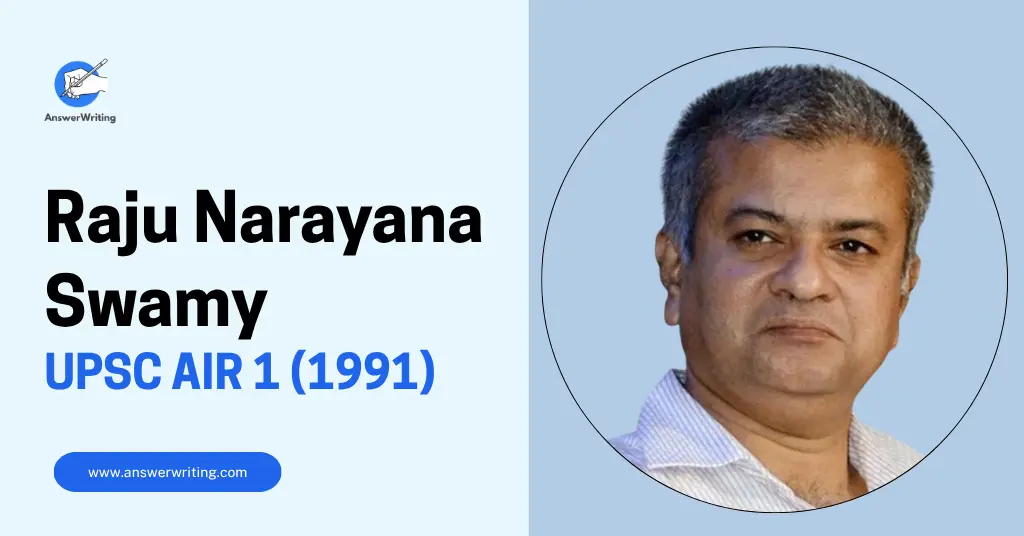
Raju Narayana Swamy: UPSC Rank 1, Strategy, and the Journey of an Incorruptible Officer | AnswerWriting
Raju Narayana Swamy: UPSC Rank 1, Strategy, and the Journey of an Incorruptible Officer
What drives a man to decline a full scholarship from the Massachusetts Institute of Technology (MIT) after topping IIT Madras in Computer Science? For Raju Narayana Swamy, the answer was a singular focus on serving his country. Known as a “serial topper,” he did not just pass the UPSC; he conquered it, securing All India Rank 1 in 1991 and repeating the feat at LBSNAA during training.
Who Is Raju Narayana Swamy?
Dr. Raju Narayana Swamy is a 1991-batch IAS officer of the Kerala cadre. He is a rare blend of extreme academic brilliance and uncompromising moral fiber. Throughout his 33-year career, he has become a symbol of integrity, famously dubbed Kerala’s “Anti-Corruption Crusader.” His professional journey is marked by over 30 transfers, a direct consequence of his refusal to bow to political pressure or bureaucratic malpractice.
Raju Narayana Swamy UPSC Marksheet and Score Details
While the exact digital marksheet from 1991 is not in the public domain, historical records from LBSNAA and the UPSC confirm his total dominance. He secured the highest marks in his technical optional subjects, which allowed him to maintain a massive lead over other candidates.
Stage
Performance Level
Mains Written
Record-breaking scores in Mathematics and Physics
Optional Subjects
Top marks in both (Back when two were required)
Personality Test
Highly rated for clarity and ethics
Final Result
All India Rank 1
Educational Background and Early Life
Raju Narayana Swamy was born in 1968 in Changanassery, Kerala, to a family of college professors. His academic record is nothing short of legendary. He secured the first rank in the SSLC examination (10th grade) in 1983 and topped the state in his Pre-Degree examination in 1985.
He then joined IIT Madras, where he graduated with a CGPA of 9.41 in Computer Science, standing first in his batch. Despite receiving a full scholarship to pursue a PhD at MIT, he chose to return to India. His upbringing instilled a deep sense of discipline and intellectual curiosity, which later manifested in him earning two PhDs and writing over 35 books.
How Many Attempts Did Raju Narayana Swamy Take?
Raju Narayana Swamy cleared the UPSC Civil Services Examination in his very first attempt. He approached the exam with the same precision he used at IIT Madras.
He emphasizes that the first attempt is often the most potent because of the sheer energy and focus a candidate brings. However, he also cautions that this requires an “uncluttered” strategy. Today, many aspirants find it hard to manage the sheer volume of information. Using an AI Mentor like the one on AnswerWriting.com can help streamline this process, providing a structured roadmap that mirrors the focused discipline Swamy used to crack the exam on his first try.
Raju Narayana Swamy Optional Subjects: A Mathematical Edge
In 1991, the UPSC pattern required candidates to choose two optional subjects. Leveraging his engineering background, Swamy chose Mathematics and Physics. He also reportedly utilized his deep knowledge of Malayalam Literature to enhance his writing style.
Mathematics: His core strength. He treated it as a purely objective paper where he could maximize marks with 100% accuracy.
Physics: He used his technical understanding to write precise, point-based answers that left little room for subjective deduction by examiners.
His strategy was to ensure his optional subjects acted as “score multipliers.” He did not just study the syllabus; he mastered the application of concepts, a technique that remains the most effective way to score high in technical optionals today.
UPSC Preparation Strategy of Raju Narayana Swamy
Swamy’s strategy was rooted in “Scientific Revision.” He believed that the human brain requires constant reinforcement to convert short-term memory into long-term assets.
Strict Timetable: He followed a rigorous 10 to 12-hour study schedule, divided into slots for core subjects and current affairs.
Breadth and Depth: He did not rely on simplified notes. He preferred standard textbooks to ensure he understood the “why” behind every fact.
Cross-Subject Linking: He linked his technical knowledge with social issues, making his General Studies answers more analytical and multidimensional.
Books and Resources Recommended by Raju Narayana Swamy
Swamy relied on foundational texts that provided conceptual depth rather than quick-fix guides.
Subject
Resource
Author/Source
Mathematics
Linear Algebra / Real Analysis
Standard University Texts
Physics
Concepts of Physics
H.C. Verma / Resnick & Halliday
Polity
Indian Constitution
D.D. Basu
History
India’s Struggle for Independence
Bipan Chandra
General Science
Nano Muthal Nakshatram Vare
(Authored by Swamy himself later)
Mains Answer Writing Approach
For Raju Narayana Swamy, Mains answer writing was about “Logical Flow.” He treated every answer like a mini-thesis. He ensured that his answers were structured with a clear introduction, a data-backed body, and a pragmatic conclusion.
He utilized his literary skills to ensure his language was sophisticated yet accessible. To achieve this level of maturity in writing, consistent evaluation is necessary. Aspirants today often use the Full Length Test Evaluator on AnswerWriting.com to simulate the actual exam environment. This tool provides the kind of holistic feedback on time management and answer structuring that Swamy practiced manually to ensure his written papers were flawless.
Interview (Personality Test) Experience
His interview was a reflection of his uncompromising nature. He was questioned on his shift from Computer Science to the Civil Services. His answer was clear: he wanted to be where he could make the most significant impact on the lives of the common people.
He maintains that the interview board looks for “backbone.” They seek candidates who can stand their ground when their ethics are tested. His performance in the interview solidified his position as AIR 1, proving that a strong personality is as important as a sharp mind.
Service and Cadre Allotted to Raju Narayana Swamy
Swamy was allotted the IAS in his home cadre of Kerala. His career is a saga of administrative bravery. He gained national attention as the District Collector of Idukki during the Munnar demolition drive, where he took on powerful land encroachers.
His refusal to compromise led to 31 transfers in 33 years. He has served in diverse roles, from the Chairman of the Coconut Development Board to the Principal Secretary of Parliamentary Affairs. Despite the professional isolation that often comes with being a whistleblower, Swamy remains a hero to the public, proving that the IAS is a platform for genuine service.
Key Lessons Every UPSC Aspirant Can Take from Raju Narayana Swamy
Academic Discipline: There is no substitute for hard work and mastery over your subjects. Aim to be a “topper” in your understanding, not just your rank.
Integrity is Non-Negotiable: The exam is just the beginning. The real test is whether you can maintain your values once you are in the system.
Continuous Learning: Even after becoming an IAS officer, Swamy earned two PhDs and wrote 35 books. Never let your intellectual curiosity die.
Resilience: Success and transfers may go hand-in-hand for an honest officer. Prepare yourself mentally for a career that prioritizes duty over comfort.
FAQs About Raju Narayana Swamy
What was Raju Narayana Swamy’s rank in UPSC?
He secured All India Rank 1 in the 1991 Civil Services Examination.
How many times was Raju Narayana Swamy transferred?
As per available reports, he has been transferred over 31 times in his 33-year career due to his stance against corruption.
What was his optional subject?
He chose Mathematics and Physics as his optional subjects, leveraging his IIT Madras background.
Which college did Raju Narayana Swamy attend?
He is an alumnus of IIT Madras, where he graduated in Computer Science and Engineering.
Is Raju Narayana Swamy still in service?
Yes, he is currently serving as the Principal Secretary to the Government of Kerala.
How many books has he written?
He has authored over 35 books, including his award-winning travelogue “Santhimantram Muzhangunna Thazvarayil.”